
Practical JTBD

Courses

Learn to test an idea yourself

There's no other program like this. You're on the frontier of reliable innovation.

This method removes nearly all the bias you get when consultants do this work, because it's a system, not chaos. And every step is 100% auditable.

I've worked at several strategy consultancies, including one known for its Jobs-to-be-Done method. That kind of research tells you what to aim for, but it aims at the customer's experience: how they buy and use what already exists. Design thinking tells you how people feel, then leaves you guessing what to build. Lean startup tells you to ship fast and fail fast, so you learn by burning time and money.

None of them can change the underlying cost curve, because your customer can't tell you how. A passenger can't design the jet engine.

This course shows you how to build it, step by step, from first principles, with no one needed to interpret it for you. We raise the job to a higher level, just as we teach you to.

Need to move faster? Venture Proof automates this whole system.

Self-paced lessons that show you how to test a business idea by hand, one step at a time. Want help with a real decision? Book a call.

Free tools

Start here: Module 1 is free

Bring one idea. Module 1 helps you cut it down to what's really true, at your own pace.

Free

Module 1: Reduce It to the Immutable Truth

Cut any idea down until nothing else can go, then tie what's left to a real law.

  • All 7 lessons in one place
  • About 56 minutes of video
  • Worksheets to use as you go
  • Free, and you go at your own pace
Available now: Modules 2, 3 and 4

These pick up right where Module 1 leaves off.

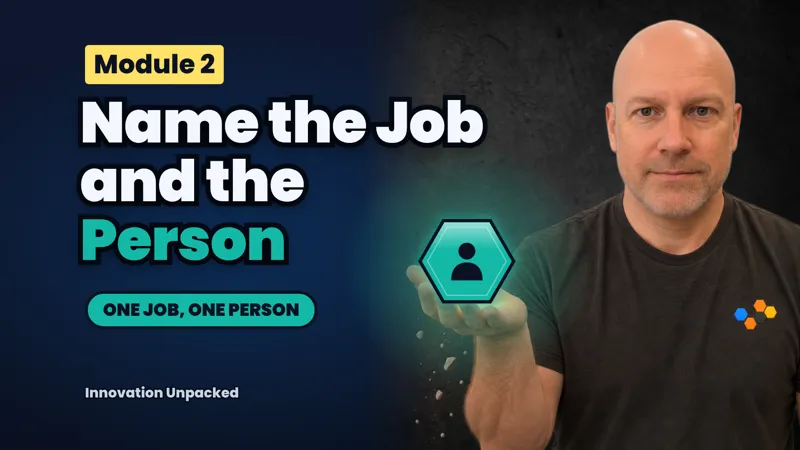
Module 2: Name the Job and the Person Who Does It

Turn your truth into one job and the one person who does it today, with no product in the sentence.

The 7 lessons in Module 2

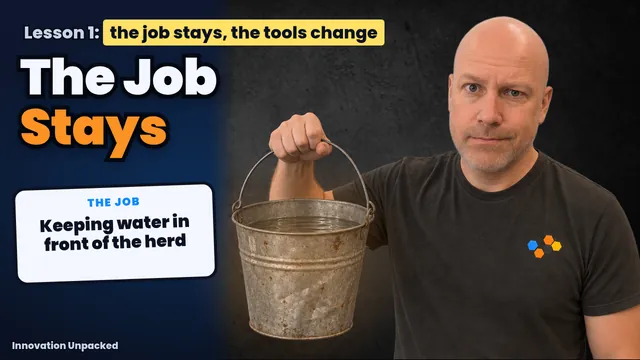
  1. Lesson 1 thumbnail: Mike holds an old metal bucket next to the words The Job Stays

    Lesson 1: The Job Stays, the Tools Change

    Learn to tell a job from a tool, so you see a market as people plus a job, not your product.

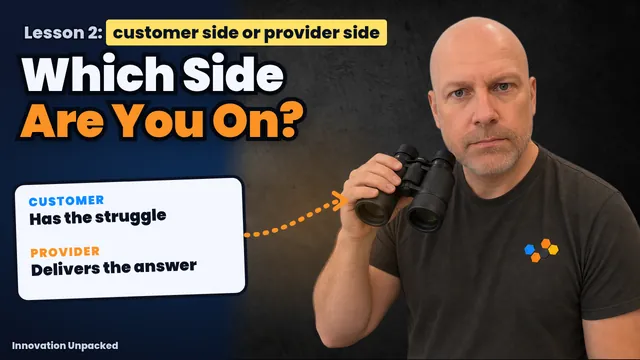
  2. Lesson 2 thumbnail: Mike looks through binoculars next to the words Which Side Are You On?

    Lesson 2: Customer Side or Provider Side

    Check which side you're on, then trace your Module 1 truth to what can go wrong and what it costs.
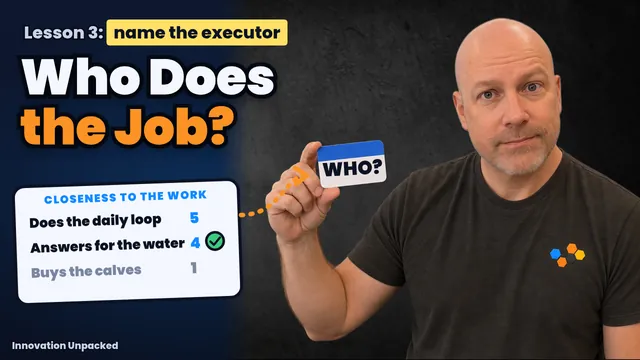
  3. Lesson 3 thumbnail: Mike holds a name tag that says Who? next to the words Who Does the Job?

    Lesson 3: Name the Executor

    List a few people your truth lands on, weigh each one, and pick the one person who does the job.

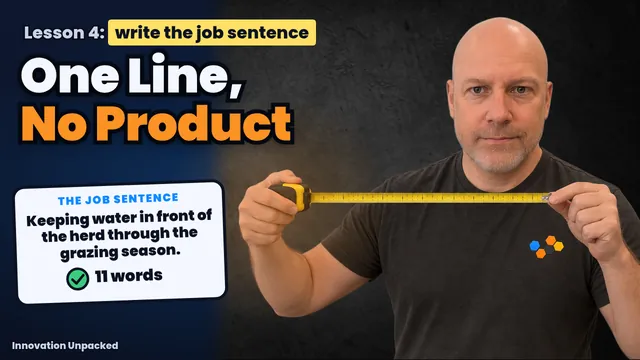
  4. Lesson 4 thumbnail: Mike stretches a tape measure next to the words One Line, No Product

    Lesson 4: Write the Job Sentence

    Write the job your person is trying to get done in one short line, with no product in it.

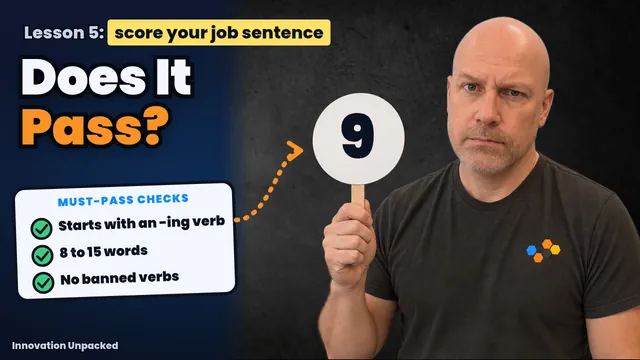
  5. Lesson 5 thumbnail: Mike holds up a score card with a 9 next to the words Does It Pass?

    Lesson 5: Score Your Job Sentence

    Run ten pass or fail checks on your job sentence, then score it to see how strong it is.

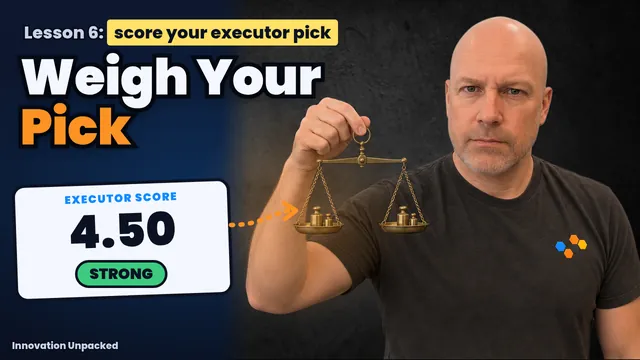
  6. Lesson 6 thumbnail: Mike holds a balance scale next to the words Weigh Your Pick

    Lesson 6: Score Your Executor Pick

    Score the person you picked on twelve parts to see if they're the right one.

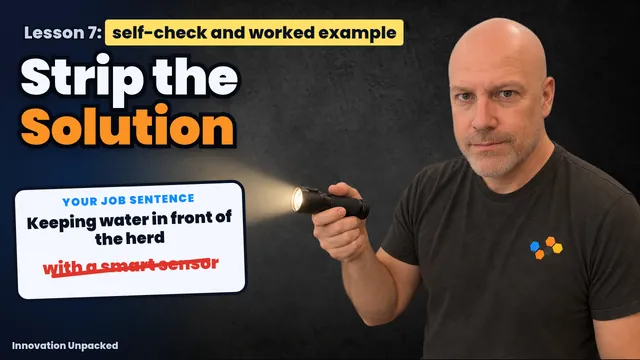
  7. Lesson 7 thumbnail: Mike shines a flashlight on a job sentence next to the words Strip the Solution

    Lesson 7: Self-Check and Worked Example

    Run one go or no-go check on your whole page, then compare it with a worked example.

Module 3: Draw the Job as a Tuesday

Map how that person gets the job done today, step by step. Then try to break the map yourself.

The 7 lessons in Module 3

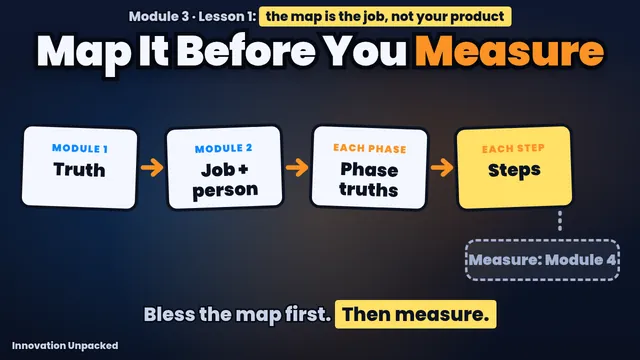
  1. Lesson 1 thumbnail: a chart that runs from truth to job and person to phase truths to steps, with the words Map It Before You Measure

    Lesson 1: The Map Is the Job, Not Your Product

    See why you map how the job gets done today, not how your product would do it.

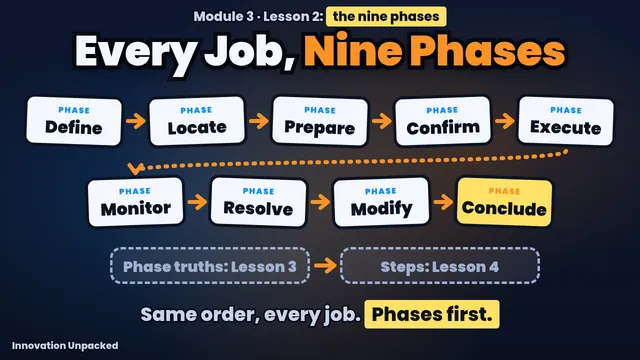
  2. Lesson 2 thumbnail: the nine phases from Define to Conclude in a row, with the words Every Job, Nine Phases

    Lesson 2: The Nine Phases

    Learn the nine phases every job goes through, from figuring out what's needed to wrapping up.

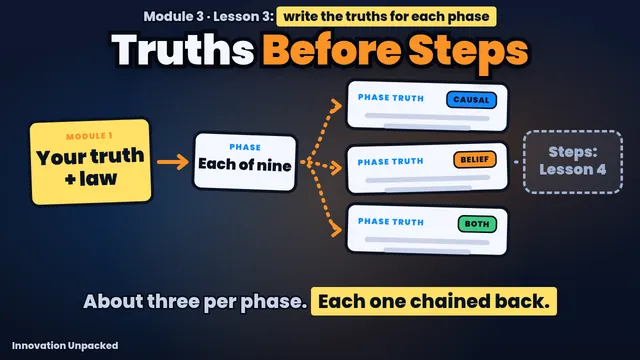
  3. Lesson 3 thumbnail: your truth branches into phase truths marked causal, belief and both, with the words Truths Before Steps

    Lesson 3: Write the Truths for Each Phase

    Write what has to hold in each phase for the job to go well, and tie each one back to your truth.

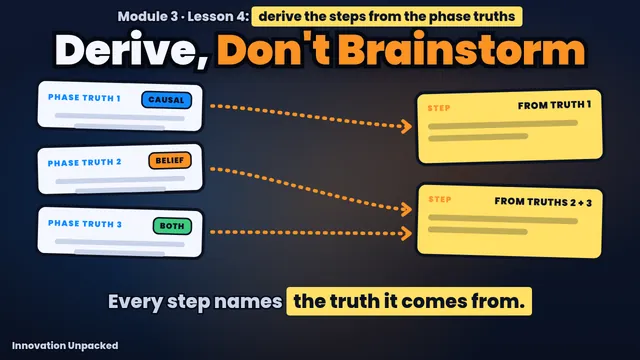
  4. Lesson 4 thumbnail: phase truths with arrows to the steps that come from them, with the words Derive, Don't Brainstorm

    Lesson 4: Derive the Steps from the Phase Truths

    Turn your phase truths into the steps your person takes today, with no tools named.

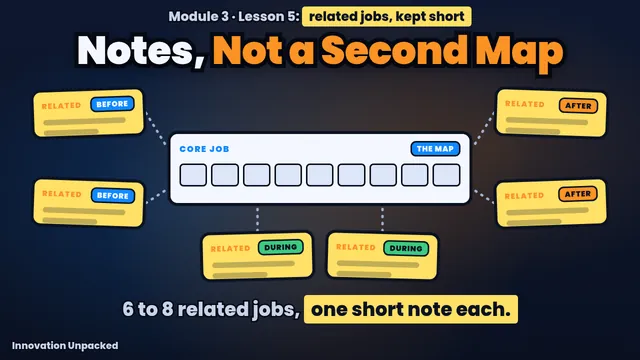
  5. Lesson 5 thumbnail: a core job surrounded by short notes for related jobs, with the words Notes, Not a Second Map

    Lesson 5: Related Jobs, Kept Short

    Find the 6 to 8 jobs around your core job and keep each one as a short side note.

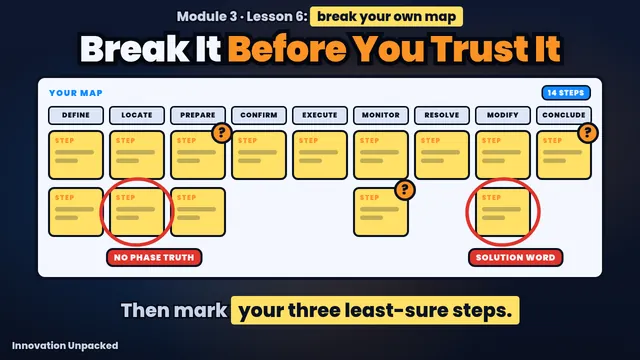
  6. Lesson 6 thumbnail: a job map with problem steps circled in red, with the words Break It Before You Trust It

    Lesson 6: Break Your Own Map

    Hunt for seven common faults in your map, fix them, and mark the steps you're least sure of.

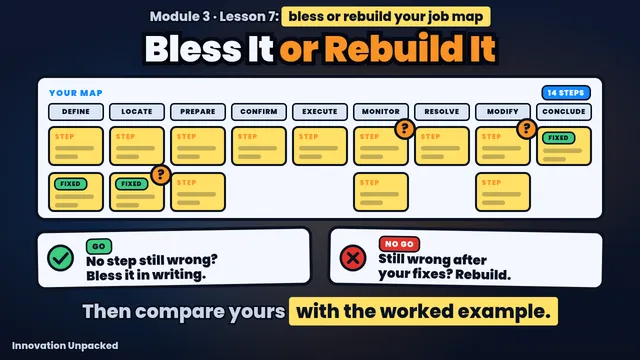
  7. Lesson 7 thumbnail: a job map with go and no-go boxes below it, with the words Bless It or Rebuild It

    Lesson 7: Bless or Rebuild Your Job Map

    Run one last check on your whole map, then sign off on it or rebuild the part that's wrong.

Module 4: Put a Number on the Gap, Then Be Willing to Kill It

Put a real number on what the job costs today and the least it could cost. Then decide if the idea is worth keeping.

The 11 lessons in Module 4

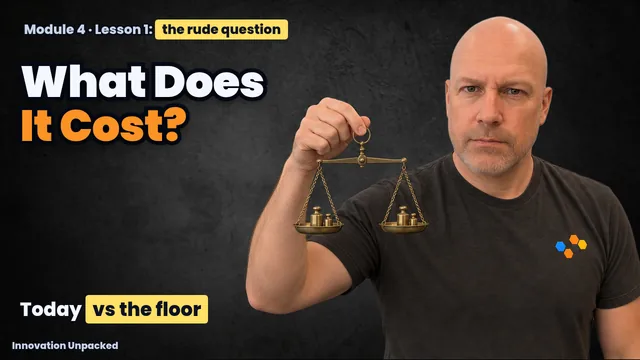
  1. Lesson 1 thumbnail: a man holding a balance scale, with the words What Does It Cost? and Today vs the floor

    Lesson 1: The Rude Question

    Ask what the job costs today and the least it could ever cost, and learn the order you'll answer it in.

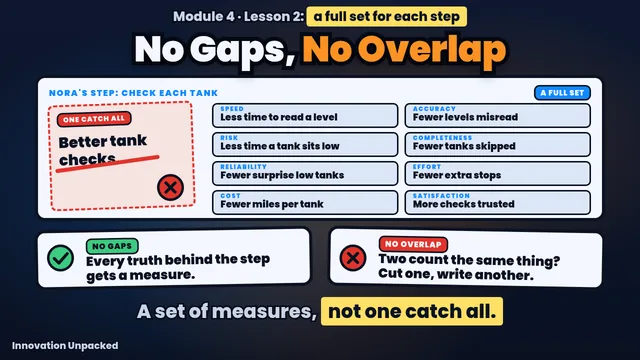
  2. Lesson 2 thumbnail: a step's list of measures with one vague line struck out, with the words No Gaps, No Overlap

    Lesson 2: Measures for Each Step

    Swap the one vague line under each step of your map for 10 clear measures you can count.

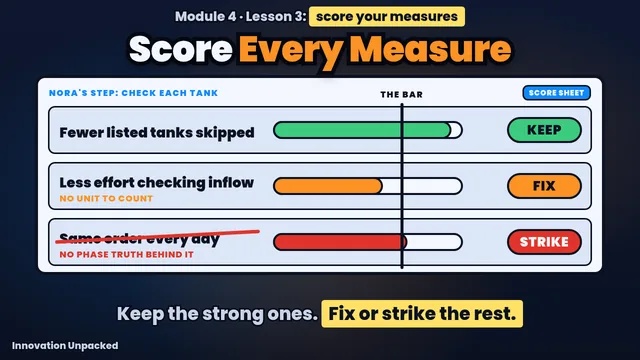
  3. Lesson 3 thumbnail: measures scored against a bar and marked keep, fix or strike, with the words Score Every Measure

    Lesson 3: Score Your Measures

    Score every measure with the same five questions, then keep, fix or strike each one.

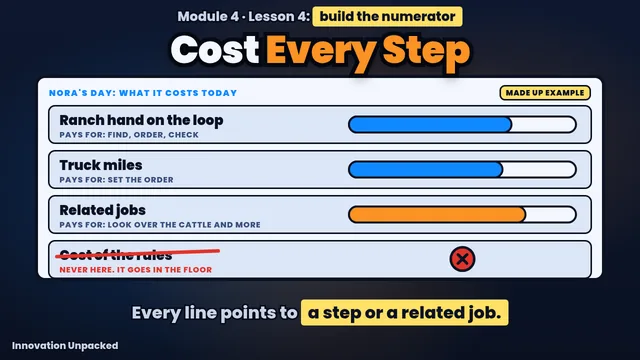
  4. Lesson 4 thumbnail: a cost sheet where each line points to a step or a related job, with the words Cost Every Step

    Lesson 4: Build the Numerator

    Add up what one run of the job costs today, with a source for every line.

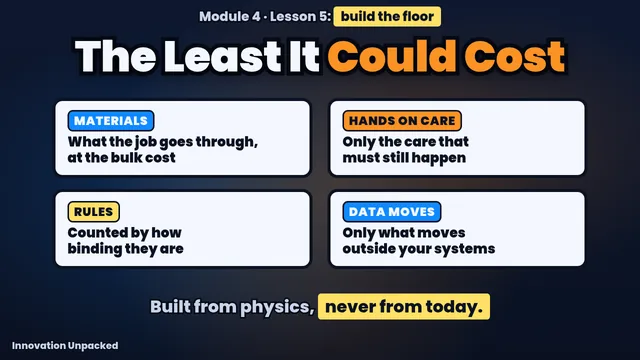
  5. Lesson 5 thumbnail: four boxes for materials, rules, hands on care and data moves, with the words The Least It Could Cost

    Lesson 5: Build the Floor

    Work out what that same run would cost with all the waste gone, using only physics and rules.

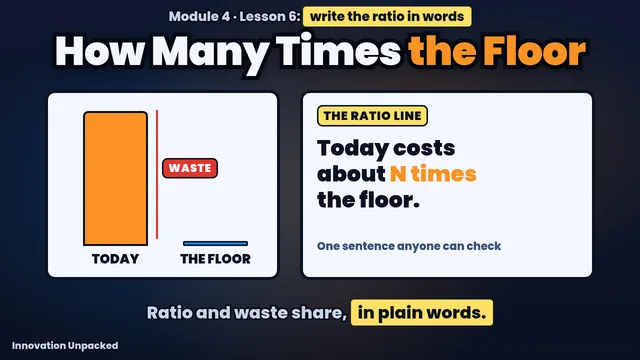
  6. Lesson 6 thumbnail: a tall bar for today next to a short bar for the floor, with the words How Many Times the Floor

    Lesson 6: Write the Ratio in Words

    Turn both sheets into one plain line anyone can check: today costs about N times the floor.

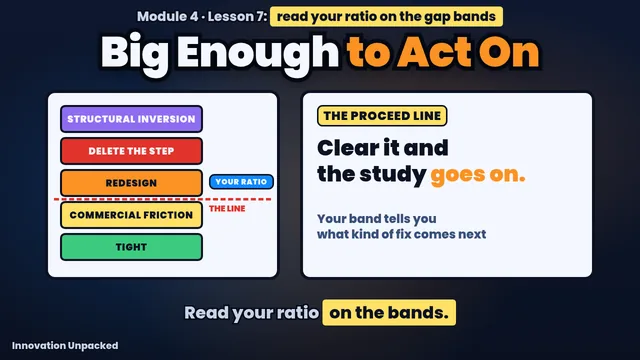
  7. Lesson 7 thumbnail: five gap bands stacked from tight to delete the step, with the words Big Enough to Act On

    Lesson 7: Read Your Ratio on the Gap Bands

    Place your ratio on five bands to see what kind of fix the gap calls for and if it clears your line.

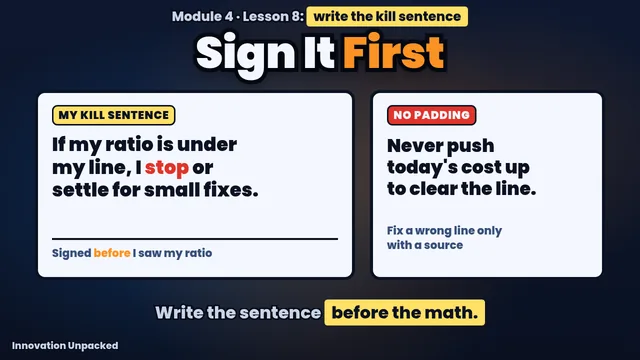
  8. Lesson 8 thumbnail: a signed kill sentence next to a no padding rule, with the words Sign It First

    Lesson 8: Write the Kill Sentence

    Write down what you'll do if your ratio falls short, before you do the math.

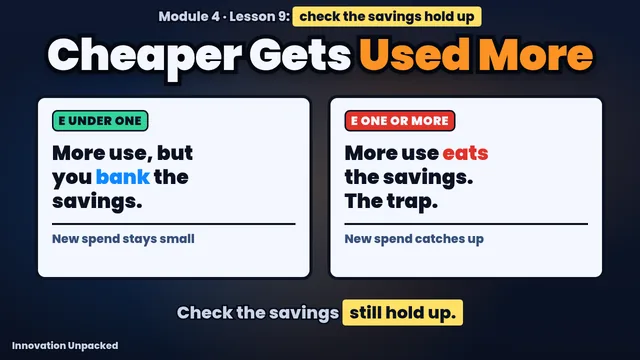
  9. Lesson 9 thumbnail: two cards showing what happens when a cheaper job gets done more, with the words Cheaper Gets Used More

    Lesson 9: Check the Savings Hold Up

    Check how much of your savings are left once a cheaper job gets done more often.

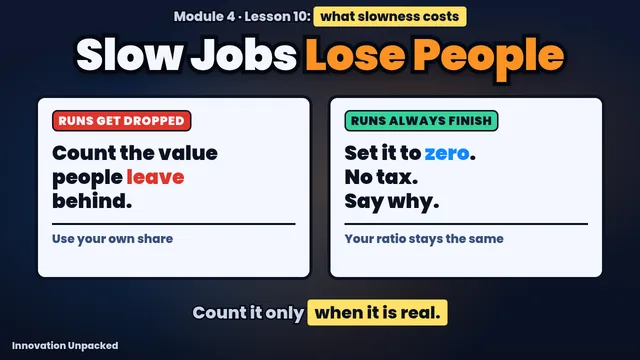
  10. Lesson 10 thumbnail: two cards for runs that get dropped and runs that finish, with the words Slow Jobs Lose People

    Lesson 10: What Slowness Costs (optional)

    If people give up on your job partway, count the value they leave behind. This one's optional.

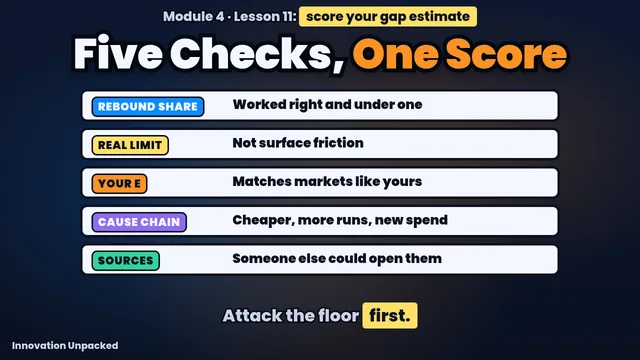
  11. Lesson 11 thumbnail: five checks listed in a stack, with the words Five Checks, One Score

    Lesson 11: Score Your Gap Estimate

    Score the work behind your numbers, test your weakest figures, and get ready for Module 5.

32 templates across Modules 1 to 4

Venture Proof. Every worksheet you fill in, lesson by lesson. Click or tap any one to see it bigger.

Module 1: Reduce It to the Immutable Truth 7 templates

Module 2: Name the Job and the Person Who Does It 7 templates

Module 3: Draw the Job as a Tuesday 7 templates

Module 4: Put a Number on the Gap, Then Be Willing to Kill It 11 templates

Previews are blurred on purpose. You get the full templates with each Module.

Coming soon: Modules 5 to 13

These come after Module 4. Join the waitlist for any module to hear when it opens. It's free.

Coming soon

Module 5: Find the Clusters, Then Talk to a Real Person

Rate the friction on each step of your map, then talk to at least two people who do the job.

Coming soon

Module 6: The 4+1 Inversions

Learn the four ways to change the shape of a cost, plus the one that comes after.

Coming soon

Module 7: The 154 Levers

Learn the 154 levers that change the shape of a cost, one group at a time.

Coming soon

Module 8: Pick the Lever and the Growth Path

Aim one big change at the problem your interviews confirmed, then pick a way to grow that fits.

Coming soon

Module 9: The Business Model and Moat

Write down who pays, what each unit costs you, and what keeps others from copying you.

Coming soon

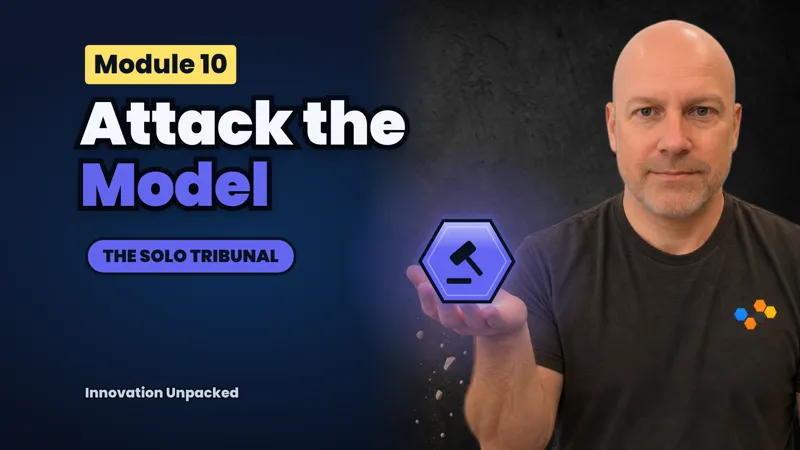
Module 10: Attack the Model

Attack your own model before anyone else does, then rule on it: keep it, fix it, or drop it.

Coming soon

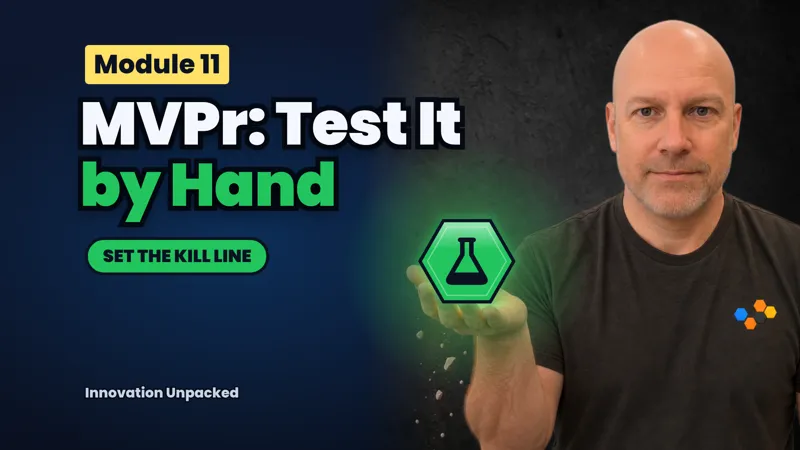
Module 11: Design the By-Hand Test and the Kill Line

Deliver your idea by hand to a few real buyers, and set the line that tells you to stop.

Coming soon

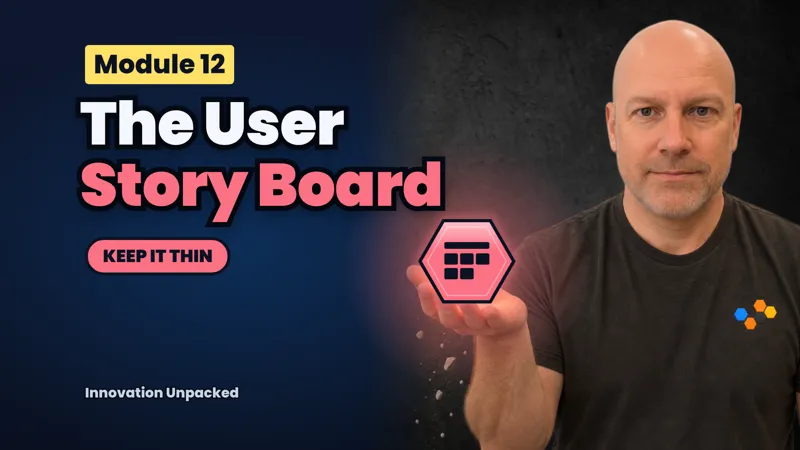
Module 12: The User Story Board

Turn your map and your hand test into a plan for what to build first, and keep it thin.

Coming soon

Module 13: The One-Page Brief and the Market Signal

Explain your bet to a skeptic in one page, then name the one market sign that would make you stop.

Work with me

Have a real decision coming? Talk it through with me first.

Advisory: test a big bet before you spend

For leaders with a real decision coming. We test the bet and make it stronger before you spend.

Coaching session

A 90 minute, ask me anything session about your idea. After we talk, you get one written analysis.

Share it and earn

You don't have to buy anything to start. If you've got a Whop account, you can get your own link for coaching and for Modules 2, 3 and 4, plus later modules once they open. When someone buys through your link, you earn 20% of the sale if you're already a member, or 10% if you're not. Whop tracks it and pays you after a 30 day hold.

Have a big bet coming up?

Book a call. We start with your decision and the real question behind it. If I'm not the right help, I'll tell you.